May 2022 Newsletter
165 East 2200 North
North Logan, UT 84341
Council Given in 2002
On January 20, 2002, the First Presidency, issued a letter to the Priesthood leadership of the Church of Jesus Christ of Latter-day Saints on the topic of Home Storage and Financial Reserves. This letter states, “Priesthood and Relief Society leaders should teach the importance of home storage and securing a financial reserve. These principles may be taught in ward councils or on a fifth Sunday in priesthood and Relief Society meetings.”
President Russell M. Nelson stated in October 2020 General Conference, “For decades, the Lord’s prophets have urged us to store food, water, and financial reserves for a time of need. The current pandemic has reinforced the wisdom of that counsel. I urge you to take steps to be temporally prepared.”
Questions we have been asked.
People often ask us what they should put into their food storage. Our answer is ‘store what you eat, and eat what you store.’
You should store foods that you normally eat and try to work up to a three-month supply. Once you have your three-month supply, you can start working on longer-term storage of food staples such as wheat, rice, pasta, oats, beans, potatoes, etc. If you choose to store foods that are not part of your normal diet, such as wheat in #10 cans, open a can and start preparing some recipes to see if the food item will be eaten by your family, or if anyone might be allergic to it. We have known people who stored lots of wheat only to find that some family members were allergic to wheat.
Another question is how to prepare these long-term storage foods? There are lots of recipes online. Do a search in your browser for Food Storage Recipes and lots will come up. Try some of these recipes so you will know how to prepare them when needed.
Something to Ponder
Our course of study this year in Come Follow Me is the Old Testament. One of my favorite accounts is that of Joseph, who was sold into Egypt. When Joseph was 30 years of age Pharaoh asked him to interpret his dreams and, through inspiration from the Lord, he provided Pharaoh with the correct interpretation. After interpreting Pharaoh’s dreams Joseph recommends to Pharaoh that he look for a man discreet and wise, and set him over the land of Egypt. Pharaoh’s response to Joseph is, “God hath shown you all this, there is none so great and wise as thou art”. As we have studied this account the Lord, through a series of events, placed Joseph on a path to fulfill this role he was asked to do by Pharaoh. And Pharaoh recognized that Joseph had a gift given him from God, but what he was actually doing was placing a Prophet of God in charge of Egypt’s food storage program.
Because Pharaoh trusted Joseph, so did the people of Egypt. Joseph had the people of Egypt plant grains that they would need to live on during the famine. I also felt that Joseph instructed the people of Egypt to store what they could in their homes. We learn that when the people of Egypt ran out of food they went to Joseph and bought food, then when the money ran out, they sold their animals to Joseph and when they had no more animals, they sold their property to Pharaoh. Through all of this, the people of Egypt survived the 7 lean years. But the real reason that Joseph was in Egypt was to preserve his family.
When we look at this account of Joseph being sold into Egypt, we see how the Lord, through his Prophet, saved the family of Jacob and in the process the people of Egypt. Today, we as the Lord’s people, have been instructed by his Prophets to have a food storage program. We have been taught to build a small supply of food that is part of our normal, daily diet. One way to do this is to purchase a few extra items each week to build a one-week supply of food. Then you can gradually increase your supply until it is sufficient for three months. Once we have our three months’ supply, look to establish longer-term needs, and where permitted, gradually build a supply of food that will last a long time and that you can use to stay alive, such as wheat, white rice, and beans.
Current restrictions for Patrons of Logan Home Storage Center (LHSC)
Masks are optional and are the preference of the patron.
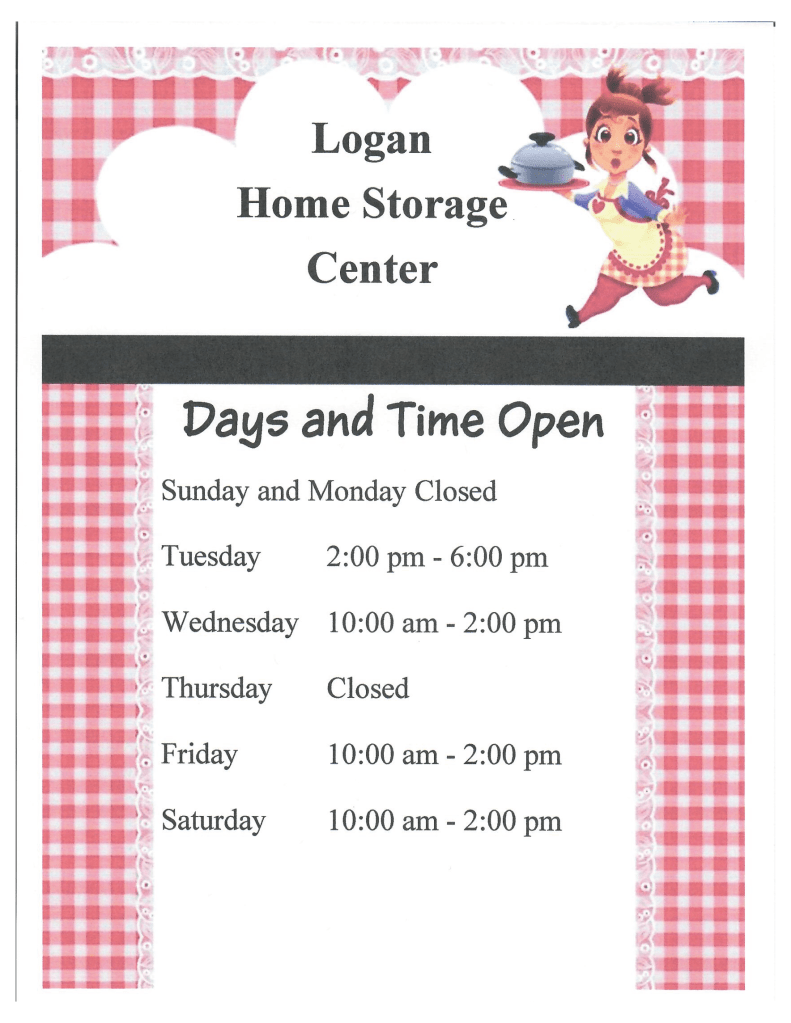
Basic Information for LHSC
All commodities in the LHSC are available on a first-come-first-served basis.
Please note that the LHSC does not accept cash or checks. They only accept credit or debit cards to pay for a patron’s order and at this time. They do not accept American Express Cards.
 Self-Reliance